


Two Story Addition
This addition was built for two developers who wanted to enlarge the footprint of their property from a single family home into two condominiums units. The plans called for a uniquely well insulated foundation and building shell as you'll see in the photos, and included a radiant heated concrete slab.
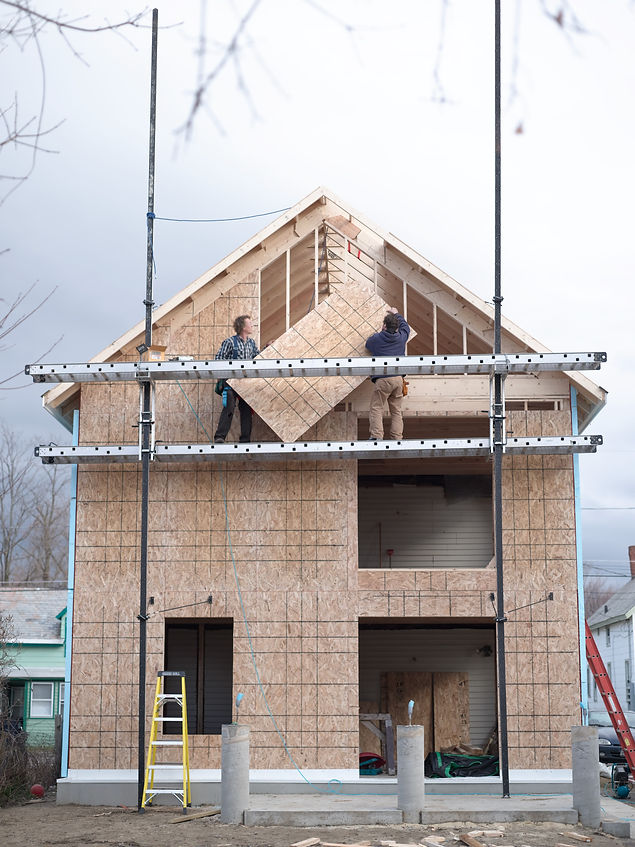
Notice the 3" thick hard foam insulation on the exterior of the home, underneath the siding:

Excavating the foundation and forming up the footing.


Heavily insulated foam blocks were used to form the concrete stem wall. An additional layer of blue foam was added.


I'm ready to pour the radiant heated floor slab, the porch floor, three columns, a step, and a small sidewalk along the building.

Radiant concrete slabs are an effective way to heat a home.

The framing is almost finished on the left, and the building completed on the right.

The finished project from the front sidewalk. Very well-insulated, it blends into the old building.

Addition with large Basement room
This home was situated on a small lot and the zoning didn't allow for a change of footprint. Because there was a low existing deck platform off the back of the old kitchen addition, that area was able to be included as a covered 'impermeable surface area'. The old kitchen addtion was replaced with a new kitchen and a covered roof porch built where the deck platform had been. More space was added with a new 400 sq ft basement room underneath the covered porch area.


The old kitchen addition is seen on the left. The large basement is provided with natural lighting by means of 3" thick glass blocks set into the porch floor.
The clerestory above the new kitchen allows for natural light to come through the ceiling area


The beginning of the demolition and new excavation for the lower level.


The excavation completed and the very sandy soil shored up. The footing has been poured and I've begun forming the walls of the lower level.


The lower level has been formed with rebar and heavily insulated forming blocks. Its almost ready for the concrete pour.


These are the glass blocks set into the porch floor which extends off the back of the new addition. The back wall of the above ground new addition rests on the steel I beam you can see in the ceiling in this photo.

The openings that the solid glass blocks are set into are wrapped in a white plastic PVC trim board. While solid glass is very durable, its can conduct heat and cold, this can lead to moisture formation in certain conditions. The PVC board isn't damaged by moisture, doesn't absorb moisture, and is an insulator. That being said, because the glass is so thick it is most often the case that the condensation point, where the freezing glass in winter meets the warm air floating against the ceiling, is at a point inside the glass itself, where there is no moisture.


The staircase descends from the kitchen into the lower room. The stair treads are open to maximize light and air flow. The windows above the stairs bring more natural light to the lower room.

The framing of the new kitchen addition.


This is a cathedral ceiling, which means that there is no attic space. In a cold dominated climate, such as Burlington Vermont, where this home is located, a cathedral ceiling requires careful insulation techniques to prevent moisture formation within the ceiling cavity. It starts with a rigid foam insulation baffle against the roof decking, a compressed fiberglass batt designed for cathedral ceilings, followed by a polyurethane moisture barrier just beneath the sheetrock to prevent moisture from migrating into the wall from the living space. As you can see from the illustration, the insulation baffle allows airflow against the roof decking, which mitigates any problems if any moisture does form there.


This addition also included a new bathroom, with a skylight.


The front porch and its roof along the south side of the home were redesigned. The porch area had been an unheated 3 season space and the front door to the home was inside the porch. A new foundation for the porch area was added. The rebuild included a new roof with a cathedral ceiling w/ skylight, new double pane glass windows, and a relocation of the entry door to the front of the house.


My clients painted their home a few years after the project was completed.
